
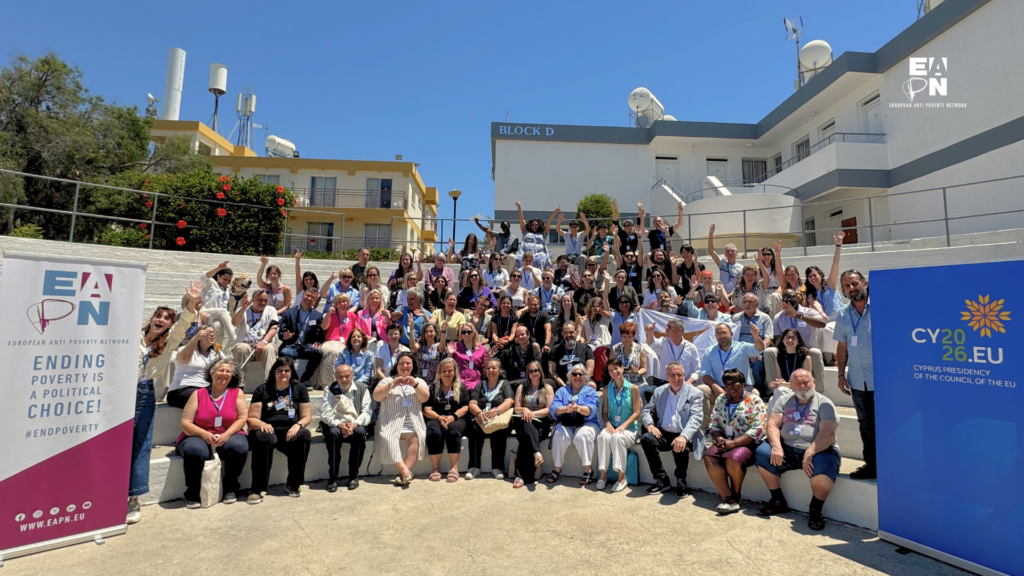
On 4–5 June 2026, people experiencing poverty (PEP), civil society organisations, policymakers and European Commission representatives gathered in Cyprus for the 24th Meeting of People Experiencing Poverty. The meeting provided a unique space to discuss how the newly launched EU Anti-Poverty Strategy (APS) can actually create meaningful change in people’s everyday lives.
Hosted by EAPN Europe and EAPN Cyprus, under the Cyprus Presidency of the Council of the European Union, the meeting focused on one central question: how can people experiencing poverty actively contribute to the implementation, monitoring and evaluation of the EU Anti-Poverty Strategy?
Turning ambition into reality
Throughout the two-day meeting, participants welcomed the publication of the EU Anti-Poverty Strategy and its ambition to eradicate poverty in Europe by 2050. However, delegates repeatedly stressed that ambitious targets alone will not be enough:
Speakers highlighted that it is necessary to move beyond declarations and ensure that the strategy translates into concrete national action plans, adequate funding, clear accountability mechanisms and meaningful participation of people experiencing poverty.
“A strategy is only as good as its implementation. It must mean concrete national plans and real accountability mechanisms.”
- Eleni Karaoli, EAPN Cyprus
Representatives from the European Commission presented the main pillars of the Strategy, including its life-cycle approach to poverty, measures to tackle housing exclusion and homelessness, efforts to improve access to quality jobs and services, and proposals to strengthen governance and monitoring across the European Union.
Lived experience at the centre
A defining feature of the meeting was the strong emphasis on lived experience as expertise. Participants shared personal testimonies about rising living costs, housing insecurity, inadequate social protection, bureaucratic barriers, discrimination and in-work poverty. Many highlighted the reality that having a job is no longer a guarantee of escaping poverty.
"Each month, I effectively work 231 hours, compared to a standard full-time workload of around 173 hours. Despite this, I am barely managing."
- Delegate from EAPN Malta
These testimonies reinforced a common message: policies work best when they are designed, implemented and evaluated together with the people they affect. Delegates stressed that meaningful participation must also consider accessibility, translation, financial support and safe participation spaces.
Key priorities for poverty eradication
During working group discussions, participants identified several priorities for the successful implementation of the EU Anti-Poverty Strategy.
Housing emerged as one of the most urgent concerns, with delegates calling for increased investment in affordable and social housing. Participants also highlighted the need for quality jobs, adequate wages, accessible healthcare, stronger social protection systems and measures to reduce administrative barriers that prevent people from accessing their rights.
"If people ask for social housing, it takes at least up to 10 years before you get it and the system is not equal."
- EAPN Poland
Education and child poverty were recurring themes throughout the discussions. Delegates underlined the importance of investing in children, strengthening school support measures and ensuring that anti-poverty policies address the needs of entire households, not only individuals.
Participants also called for stronger action to combat discrimination and stigma, recognising that poverty often intersects with disability, migration status, gender, ethnicity and other forms of exclusion.
Strengthening participation and accountability
A major outcome of the meeting was the discussion on the creation of a structured mechanism for participation within the framework of the EU Anti-Poverty Strategy.
Delegates emphasised that all Member States should be represented and that participation should be adequately resourced and supported.
Many participants highlighted the need for regular dialogue between people experiencing poverty, national governments and EU institutions. Suggestions included national and European PEP committees, stronger monitoring mechanisms, dedicated anti-poverty coordinators and better links between local, national and European levels.
A shared commitment
Despite the many challenges discussed, the meeting was characterised by a strong sense of solidarity, determination and shared purpose.
Participants agreed that the EU Anti-Poverty Strategy represents an important opportunity to advance social rights and tackle poverty in a comprehensive way. At the same time, they stressed that success will depend on sustained political commitment, adequate resources and the active involvement of people experiencing poverty at every stage of the process.
The meeting concluded with a renewed commitment to continue building this partnership and ensuring that the voices of people experiencing poverty remain at the heart of the implementation of the EU Anti-Poverty Strategy.
A big thank you to every participant who brought their voice, their story and their expertise to this space.
We are grateful to EAPN Cyprus and the Cyprus Deputy Ministry of Social Welfare for their hospitality, to the Cyprus Presidency of the Council of the EU 2026 for hosting and supporting this event, and to DG EMPLY the European Commission and the European Economic and Social Committee for their presence and continued commitment to inclusive governance.