
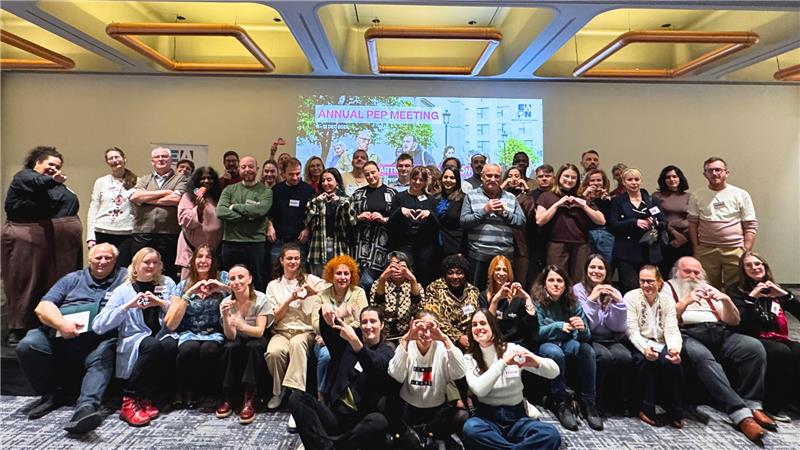
EAPN’s 23rdAnnual Meeting of People Experiencing Poverty (PEP Meeting) took place on the 11 and 12 December, in Brussels. Representing more 20 countries across Europe, 52 people experiencing poverty gathered to reflect on the future of participation. Creating also a critical space for community-building, capacity-strengthening and a platform where delegates can learn from one another, gain new tools, and develop the confidence to act individually and collectively.
This meeting took place shortly after key EU-level milestones, including the European Commission Consultation with People Experiencing Poverty ahead of the EU Anti-Poverty Strategy (Porto, September 2025) and the first Anti-Poverty Day at the European Parliament (November 2025), this year’s meeting provides an opportunity to build on the energy generated, while refocusing on personal growth, collective empowerment, and cross-border connections.
Day 1: Spaces of Learning and Influence
During the first day of the PEP Meeting, people experiencing poverty met with key EU institutions and civil society organisations. Jiri Svarc, who opened the plenary session in representation of the European Commission set up the tone by addressing the future of the EU Anti-Poverty Strategy and exchanging thoughts with participants. MEP João Oliveira showed his strong support for the report on the Anti-Poverty Strategy and stressed the need for meaningful participation, comprehensive approaches to poverty, and future ambitious targets. Participants main concerns where about empowerment, national implementation gaps, and rising inequalities. At the European Commission’s DG Employment, officials presented priorities on minimum income, homelessness, social protection, and quality jobs, emphasizing shared competences and the need for stronger Member State engagement, especially ahead of the 2028 financial framework (MFF).
A meeting with FEANTSA deepened the discussion on homelessness, underlining its rise across Europe and the importance of person-centred, housing-led approaches. The delegation also met with the European Economic and Social Committee, where discussions focused on the Committee’s role in shaping social policy, the political shift in Europe, and the need to amplify national voices in EU debates. Finally, delegates met with the Marius Jacob Foundation and discussed grassroots, participatory funding models supporting under-resourced social initiatives.
The meeting also offered a series of capacity-building workshops where participants explored how lived experiences can be transformed into lasting collective power. Through storytelling, public speaking, advocacy, digital communication, fundraising, and civic space defence, the sessions highlighted that meaningful participation goes beyond testimony and requires skills, safety, resources and influence. Participants reflected on how stories of poverty, discrimination, migration, disability, and exclusion can build movements, shape public narratives, and influence decision-makers when combined with clear messaging, inclusive networks, and strategic action.
The workshops also addressed barriers such as fear, tokenism, lack of resources, shrinking civic space, and unequal access to decision-making, while sharing practical tools to strengthen people-led advocacy, protect civic freedoms, and embed the voices of people experiencing poverty across policies, communications, governance, and funding structures.
Day 2: The Future of Participation
To guarantee that participation is meaningful and impactful, the second day of the event was a shared reflection on the future of PEP engagement.
EAPN reaffirmed its commitment to set up an internal PEP Committee to monitor and influence the upcoming Anti-Poverty Strategy. Participants discussed selection criteria such as age balance, regional representation and the inclusion of different collectives
Based on the discussion, the committee should have a consultative mandate focused on empowering people experiencing poverty, managing communication channels, and fighting for compensation and recognition of members’ skills and experience.
The delegates also reflected on the work done within EAPN and identified four main takeaways:
- Community: The most highlighted aspect was getting to know one another, exchanging experiences and creating a shared safe space to build trust. There was a clear need to maintain spaces like that where PEP participants can feel a sense of community, continue sharing stories and keep learning from each other.
- Connection: Strengthening national networking and learning from each other helped participants work together more effectively and feel more confident to engage and contribute.
- Dialogue: Exchanges with EU institutions and EAPN Europe staff were highly valued and encouraged participants to engage more with institutions at national level, recognising that poverty isa shared challenge at both EU and national levels and that connecting these spaces strengthens democratic participation.
- Empowerment: In a challenging political context, participants highlighted the need for a clear strategy at both national and EU level, combining theory and concrete case studies, shifting the narrative to fight poverty rather than people in poverty.
These four pillars will guide EAPN’s priorities, actions and strategising on this basis for its work in the coming year and towards the 2026 PEP Meeting.
A huge thank you to every delegate, facilitator and partner who made this PEP Meeting possible. In a demanding year like 2025, coming together reaffirmed our goals on the fight against poverty, strengthen to our community and renewed our motivation to turn Participation In Action.