What is poverty and how to combat it? | EAPN Explainer
We are happy to present you our Poverty Explainer on the Multidimensionality of poverty. “The problem is not that we run out of money occasionally, the real problem is that…

We are happy to present you our Poverty Explainer on the Multidimensionality of poverty. “The problem is not that we run out of money occasionally, the real problem is that…
In advance of the upcoming EPSCO meeting on the 9-10 December, and European Council Meeting on the 12-13 December, EAPN wrote letters to Social Ministers and to the “Trios” (Finnish…
EAPN has written to the President of the European Commission to ensure the AGS 2020 continues its progress towards a more balanced social/economic/environmental strategy delivering on poverty, social rights +…
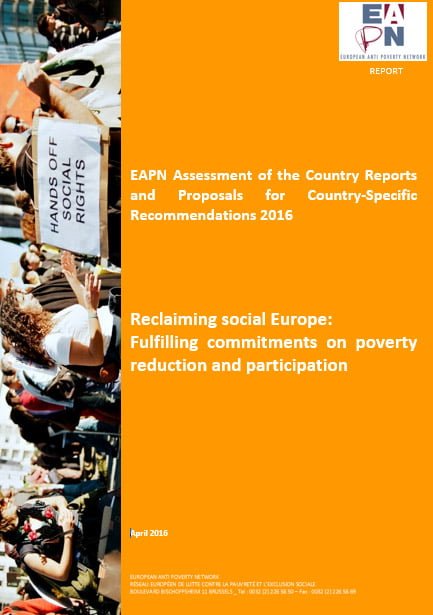
{Jathumbnail}26/04/2016 – EAPN presents its full assessment of the 2016 Country Reports, released on 26 February 2016, and puts forward proposals for Country-Specific Recommendations (CSRs), based on inputs from National Networks European Organisations in our membership. EAPN wants the European Semester to deliver results on the Europe 2020 goals of inclusive and sustainable growth, and to deliver on its target to reduce poverty by at least 20 million by 2020.

{Jathumbnail}21-03-2016 – Today EAPN released its Barometer Report – Monitoring the implementation of the (at least) 20% of the European Social Fund that should be devoted to fight against poverty during the period 2014-2020 at a side-event organised by EAPN at the Annual Convention for Inclusive Growth 2016. The aim of this report is to carry out an initial monitoring of:

03/03/2016 – EAPN launched its new booklet The contribution of meaningful Social Innovation to reducing poverty and social exclusion in Europe in the European Parliament on the occasion of a discussion on the topic: How can Social Innovation contribute to reaching the poverty reduction target of Europe 2020? co-hosted by Hon Verónica Lope Fontagné MEP (EPP) and EAPN. Social innovation has been a ‘buzz’ term in European discourse over the past years, having been actively promoted by the European Commission, and tied to important funding lines for the national and EU level. The potential of a socially innovative approach to contribute to mitigating the consequences of the crisis, as well as to ensure better social inclusion and social cohesion in Europe, has been widely praised. However, the definition and use of the concept remain tenuous, and there is still ongoing debate regarding its merits, as well as hidden traps.
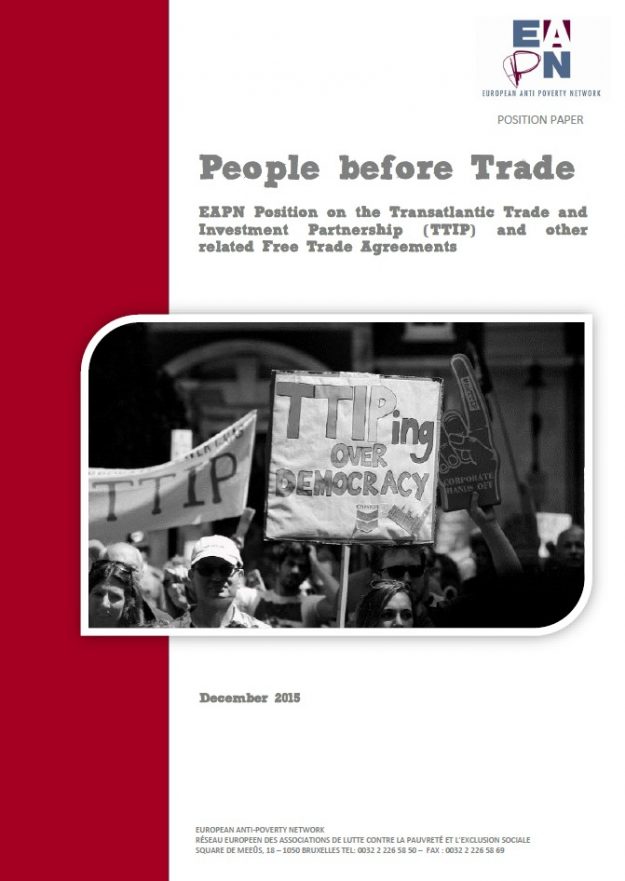
17/12/2015 – This paper outlines, in brief, the position of the European Anti-Poverty Network (EAPN) regarding international trade agreements currently being negotiated by the European Commission, on behalf of Member States, to promote free trade. It looks specifically at negotiations on agreements such as CETA, TTIP, TiSA, and tries to point out the potential consequences of these agreements, in their current form, on poverty and social exclusion in European countries.
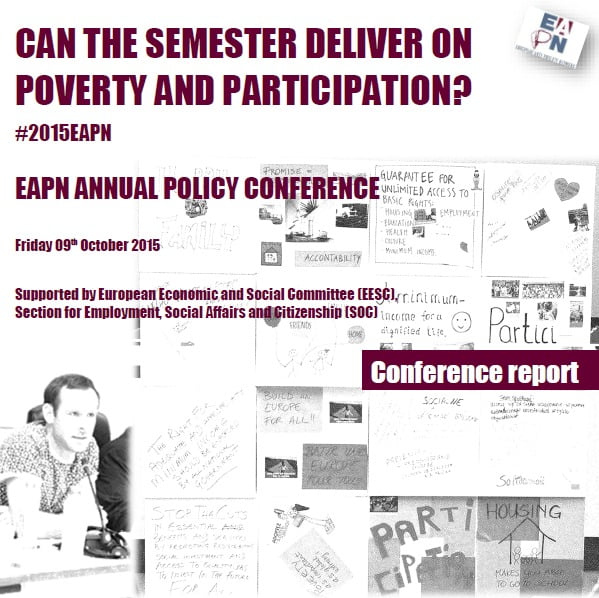
EAPN’s Annual Policy Conference (09/10/2015), held in partnership with and hosted by the European Economic and Social Committee (EESC), built on EAPN’s Assessment of the 2015 National Reform Programmes, giving evidence that poverty and participation must be put at the heart of the European Semester.
18/11/2015 – This ILO paper: (i) examines the latest IMF government spending projections for 187 countries between 2005 and 2020 ; (ii) reviews 616 IMF country reports in 183 countries to identify the main adjustment measures considered by governments in both high-income and developing countries; (iii) applies the United Nations Global Policy Model to simulate the impact of expenditure consolidation on economic growth and employment; (iv) discusses how austerity threatens welfare and social progress; and (v) calls for urgent action by governments to adopt alternative and equitable policies for socio-economic recovery.
18/11/2015 – The article “Europe 2020 and the Fight against Poverty: Beyond Competence Clash, Towards “Hybrid” Governance Solutions?” by Matteo Jessoula, published online in Social Policy & Administration, issue 4/2015, summarizes the findings of the WP4 I coordinated within the reserach project COPE-Combating Poverty In Europe.